
Keeping The Soul of Broadcast Alive: How Film & Media Students Reimagine Traditional Media
BY
JULIA ONG
Social Media Head (UW)
Hype Issue #92
Published on:
Feb 09
2026
JULIA ONG explores how Campus TV and Radio Heatwave students are keeping broadcast platforms alive amid the fast-developing media scene.
Rethinking “Evolving” Media Formats
In an era dominated by TikTok loops and colourful Instagram reels, few would expect radio studios and television control rooms to be buzzing with young student creators. Yet at Ngee Ann Polytechnic’s School of Film & Media Studies (FMS), traditional broadcast spaces remain thriving with energy. Final-year FMS students are stepping behind the mic and cameras to uphold the authenticity of radio and television in a media landscape where instantly gratifying short-form content is rising to be king. Through final-year capstone projects such as Campus TV (CTV) and Radio Heatwave (RHW), Mass Communication students are not only preserving legacy platforms but adapting them to reflect how audiences consume media today. Their approach is digital-first, collaborative, and rooted in passionate storytelling.
Campus TV as a Hybrid Broadcast Platform
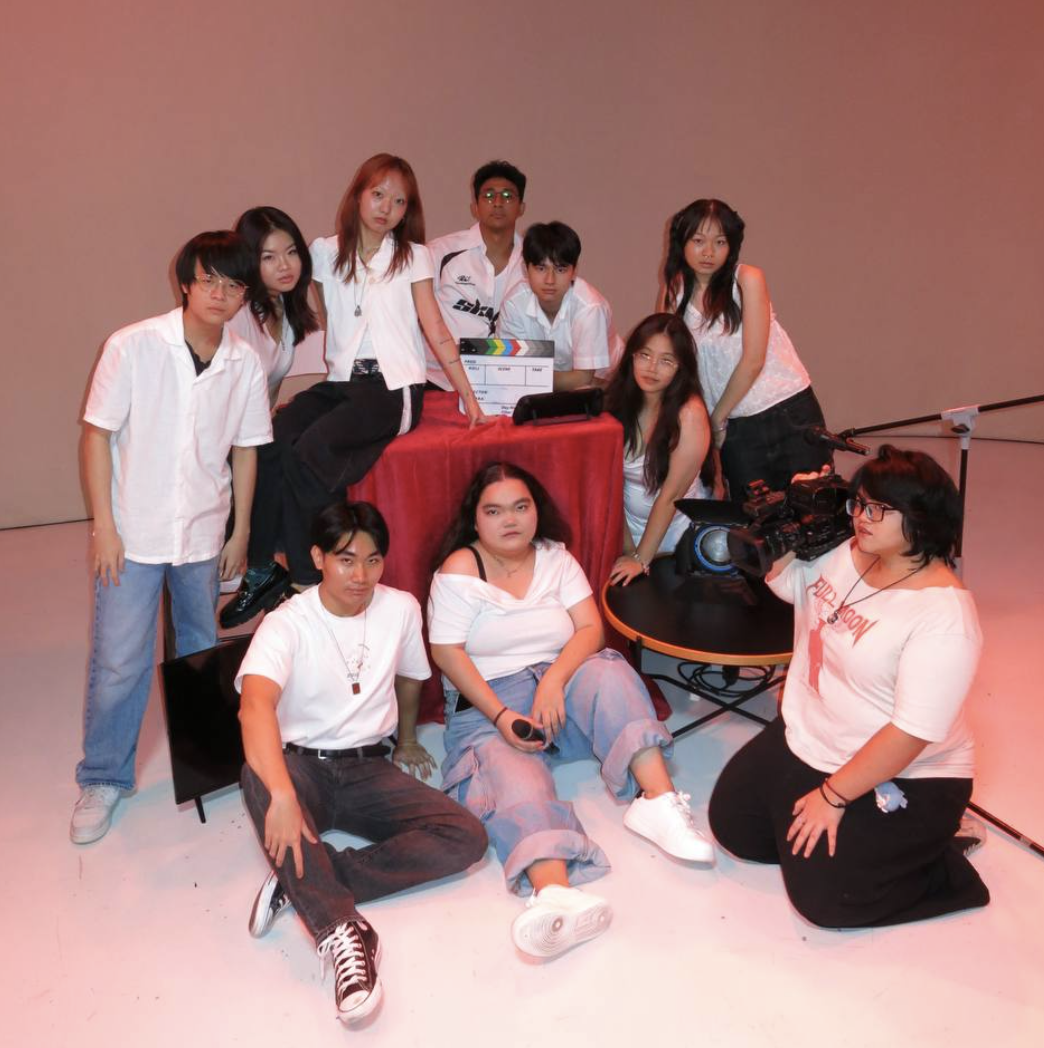
Campus TV. (Photo credit: Campus TV)
Campus TV (CTV), Singapore’s first campus television station, has long been a fixture on screens across Ngee Ann Polytechnic’s (NP) food courts. They work on a three to four-week production cycle, from pitching to post-production, with their final videos broadcast on campus screens and subsequently uploaded onto social media.
Run by a group of ten Mass Communication students and led by this semester’s Station Head, Aljean C. Totaan, CTV members are divided into Management, Production, and Social Media committees – ensuring that every piece of content is suited for all platforms. The production team focuses on camera quality, while the social media team ensures content is optimised for online platforms. They come together to challenge the perception that campus television is limited in scope or audience.
“Our objective is simple: it’s about NP, for NP,” Aljean shared. “But staying relevant means we have to move fast.”
Capturing Campus Life
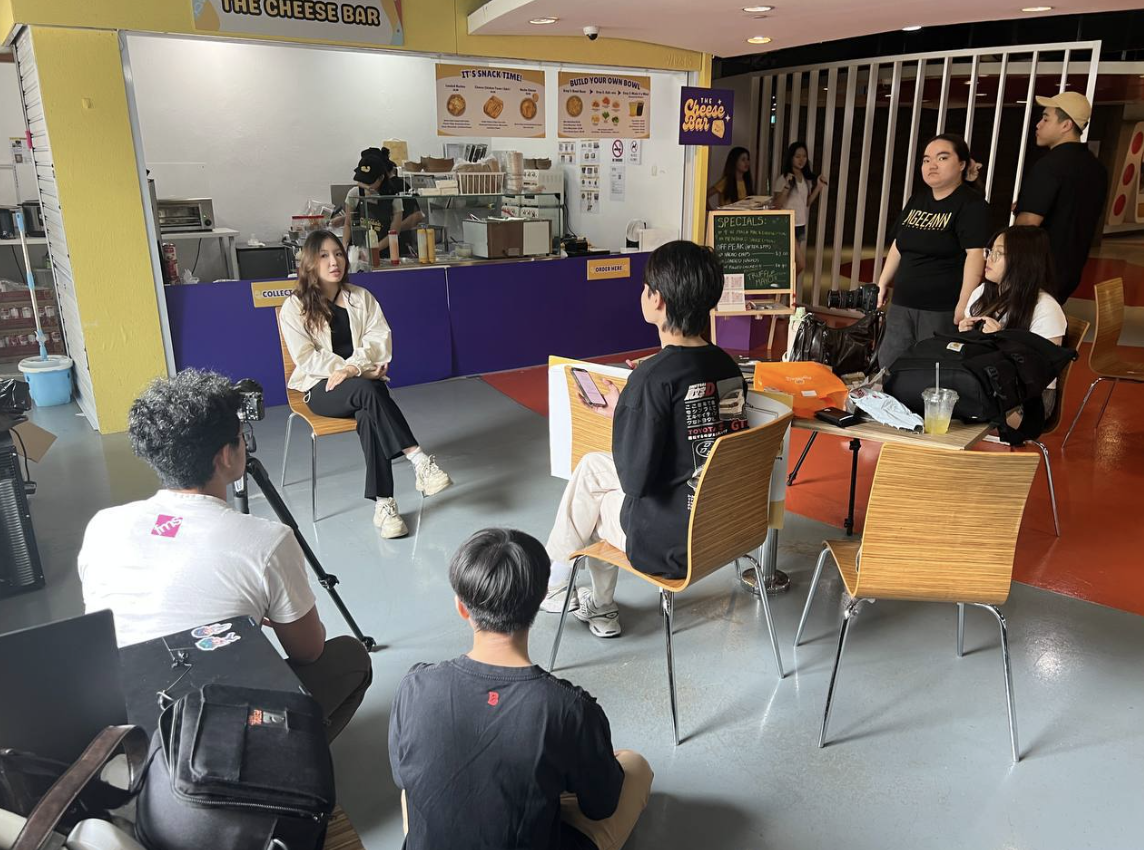
CTV crew conducting an interview for a What’s Up In NP episode (Photo credit: CTV)
.
CTV’s coverage ranges from student entrepreneurship initiatives like BYOB (Be Your Own Boss) to large-scale events such as FMS Scarefest.
BYOB (Be Your Own Boss) is a competition where students pitch their café business proposal to stand a chance to secure a grant and kickstart their business directly on Ngee Ann Polytechnic’s campus.
In their ‘What’s Up In NP (BYOB edition)’ series, each episode covers the winners of the competition, spotlighting various cafe spots that specialise in one area of food. Reflecting on the BYOB project, Aljean shared, “Tasting their food and getting to review it, [and] getting the customers’ reactions, especially because some of them were trying out the store for the first time, [was] definitely memorable [as] we were there with them. It’s always that sense of being there with the people we meet.”
For Scarefest, Aljean recounts staying up until 10 p.m. on set for three days in a row for their debut project. “I would say that the Scarefest filming was one to definitely remember because that was our inaugural shoot,” he shared. “That was, for many of us, our first time handling the DSLR cameras and [getting to] know how to work in our roles, because we had not done external shoots ever in Ngee Ann.”
For CTV, this art of creating longer and more intentional videos reflects their commitment to keeping the soul of traditional media alive.
Watching their days of effort come together on the communal screen fills CTV students with a pleasing sense of pride. Aljean shared, “When you see [your] production on the TV screens [at] Makan Place or Munch, the [videos] will definitely flush you with a sense of esprit de corps. because the whole team will [usually] be there to watch it.”
Radio Heatwave
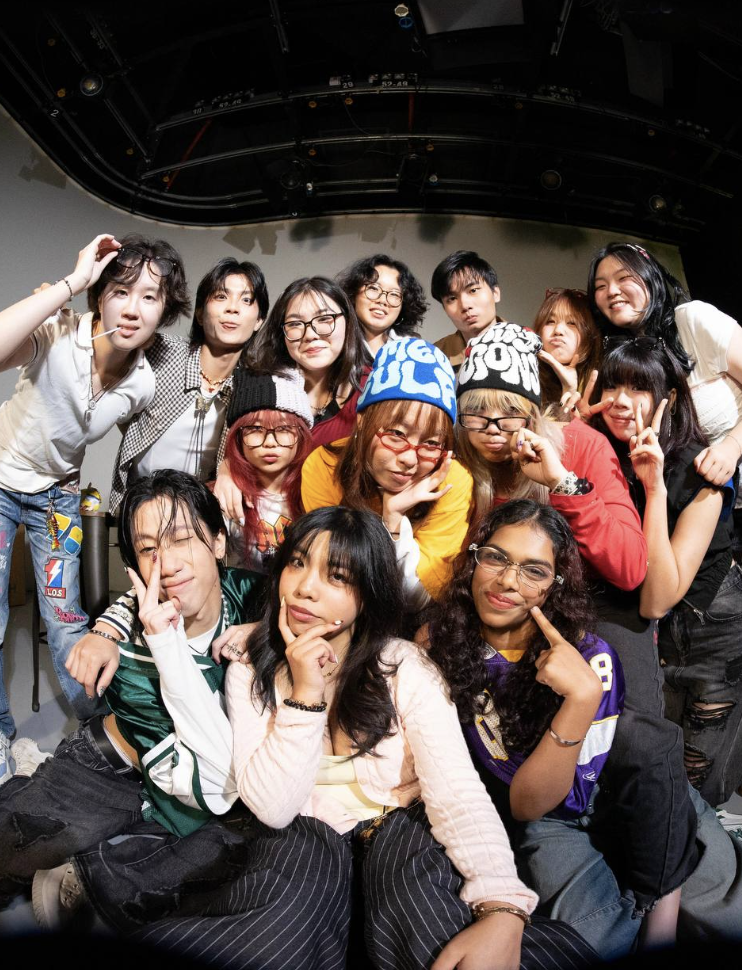
The RadioHeatwave Team. (Photo credit: Radio Heatwave)
.
While CTV reworks television, Radio Heatwave demonstrates how radio continues to evolve alongside digital media.
Led by Station Manager Amadea Chan, Radio Heatwave functions as both a campus radio station and a capstone project where students manage the station as a whole.
Each semester begins with students deciding on an overarching visual theme, which guides programming and social media output. This ideation process is important as it decides the visual layout for Radio Heatwave’s Instagram and ensures the theme stays consistent throughout the semester. Auditions are then held to recruit “baby jocks” from across NP. The term “baby jock” refers to trainee radio presenters who are still learning the ropes and are placed into shows under guidance from senior jocks or management. “They don’t have to be from Mass Communications,” Amadea explained, addressing a common assumption about the station.
Operating Across Teams and Platforms
Radio Heatwave’s structure reflects professional broadcast workflows. The station manager oversees multiple departments and acts as the main liaison for internal collaborations.
The music and production team curates weekly playlists and produces long-form content such as artist interviews for YouTube. The social media team manages Instagram, TikTok, and the station’s website, often handling campaigns for external clients. The client relations management team coordinates industry partnerships, while the events and promotions team organises live events and giveaways.
“It’s really interconnected,” Amadea says. “Everyone just has to check in with one another and make sure that we’re all in the loop.”
Traditional Media in a Digital Context
Despite the effect of streaming and mobile platforms that have reshaped media habits, an article by Spondon Tahsan suggests that traditional formats continue to hold cultural and experiential significance when paired with digital engagement strategies. For instance, it suggests that traditional formats such as linear television provide a shared collective experience where everyone watches the same thing at the same time. Traditional media formats manage to create shared social moments that can get lost in our current age of personalised algorithms.
At Radio Heatwave, this integration includes introducing weather updates inspired by national radio practices, experimenting with show formats such as Manga Mindset and Huddle Up, and curating music that reflects youth interests.
Learning Industry Realities Through Capstone
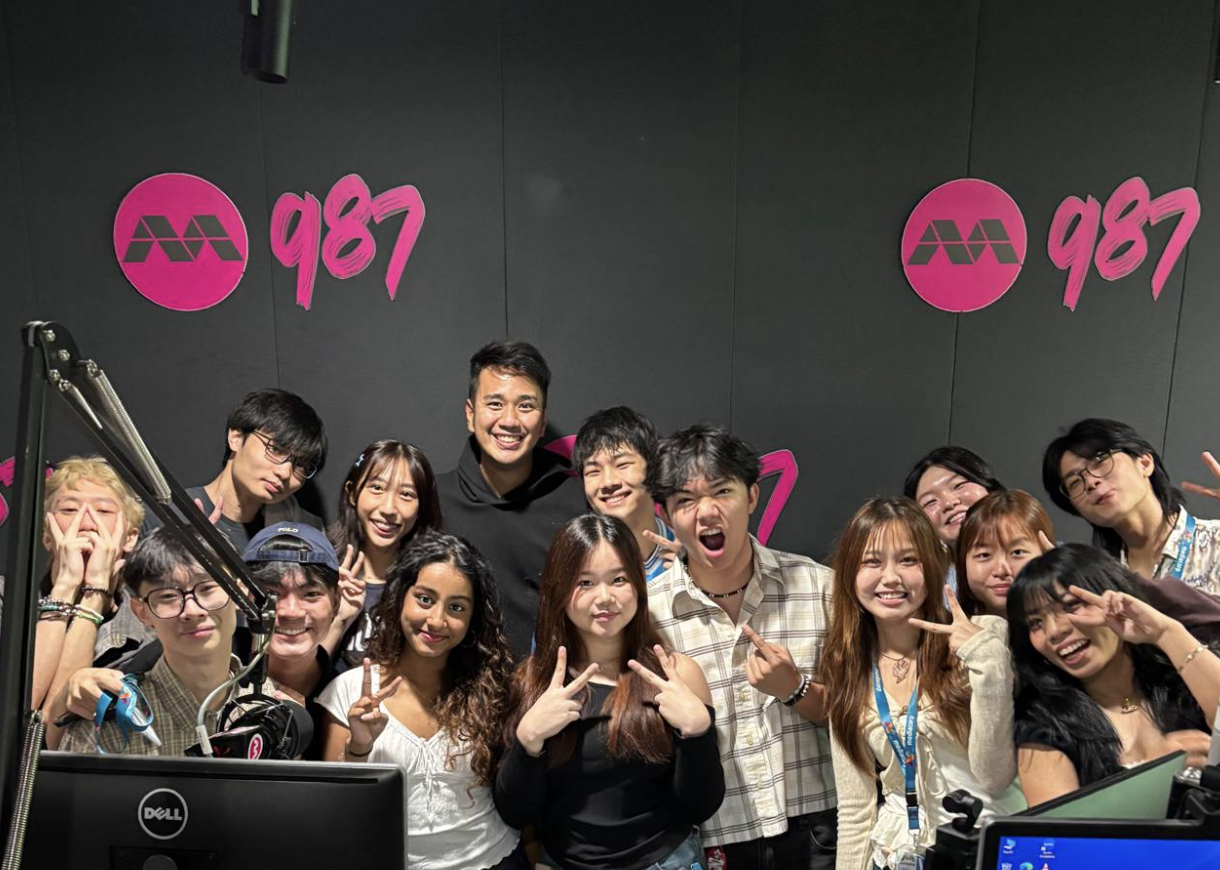
Radio Heatwave meets Joakim Gomez, radio DJ at 987. (Photo credit: Radio Heatwave)
.
Beyond content creation, Radio Heatwave and Campus TV expose students to the operational realities of media work. These include managing tight timelines, coordinating across teams, and working with real-world clients.
“You cannot think of this as a solo run,” Amadea shared. “We are not any less than any other brand out there.”
Students develop technical skills in broadcasting and production, alongside soft skills such as communication, adaptability, and collaboration.
The New Generation of Broadcasting
As FMS students approach graduation, their capstone projects demonstrate that the future of broadcast does not depend on abandoning traditional formats. Instead, it lies in rethinking how these platforms function within a broader digital ecosystem.
Through Campus TV and Radio Heatwave, students show that radio and television can remain relevant by evolving with their audiences, proving that legacy media still has a place when innovation comes from within its structure.
While the world spins on two-minute laughs for a 1080-by-1920 pixel screen, there is a small corner in Ngee Ann Polytechnic where students continue to cherish the beauty and comfort of traditional TV and Radio.