
I Brought My Grandma to Ride an
Autonomous Vehicle – Here’s How It Went
BY
WAFEEQA SULAIMAN
Deputy Editor
Hype Issue #87
Published on:
Feb 02
2026
HYPE SG explores what Singapore’s autonomous transport scene means to different generations.
When I first asked my Grandma if she would be willing to be a passenger on a “driverless” vehicle, she looked at me in disbelief. Having watched Singapore’s public transport evolve from its earliest days, the thought of buses driving themselves felt almost unreal to her. However, this future is quietly taking shape in Singapore, with more than 50 authorisations issued for Autonomous Vehicle (AV) testing since 2017, and 19 vehicles already deployed on public roads in Singapore. What once sounded like science fiction is now slowly becoming part of everyday life.
Despite her initial disbelief, being the sporting person she is, my grandma agreed to give it a go.
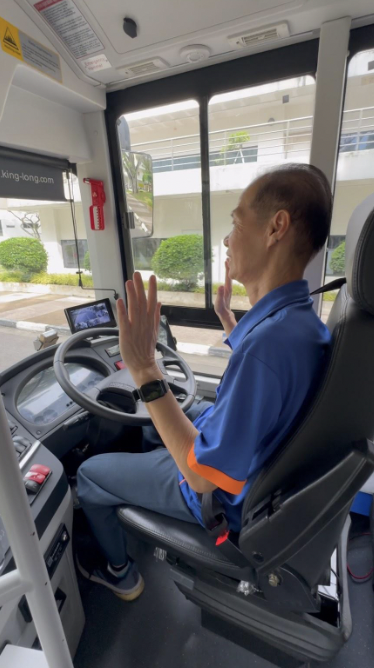
The Driver Showing us the bus being driverless (Photo credit: Ashley Lok)
A Ride on the MooVita Bus
Together, my grandma and I boarded the Moovita campus shuttle at Ngee Ann Polytechnic. This bus is one of the few AVs allowed for testing on Singapore roads. It serves as a free transport service, mainly for students and staff, running from both King Albert Park MRT and Clementi MRT to Ngee Ann Polytechnic – while also looping through multiple stops within the campus itself.
While the MooVita bus has a driver onboard, once it enters campus grounds, it switches to autonomous mode. The steering wheel moves on its own, guided by sensors and cameras, while the driver remains present as a safety measure.
I explained this to my grandma as she excitedly took a seat on the bus and buckled up, ready to embark on the journey. She watched the steering wheel move by itself with amusement, but what surprised her most was how smooth the ride felt.
“It feels like a normal bus,” my grandma shared in Tamil. When I asked if she felt scared, she shook her head. “It’s like cable cars, there’s no driver, but people still take them,” she said. I thought this was an unexpected but meaningful comparison which made the idea of driverless transport feel less alien.
How Autonomous Vehicles Actually Work
Autonomous vehicles rely on sensors, cameras, GPS and onboard systems to scan their surroundings, detect obstacles and plan safe routes in real time.
According to a 2025 article by CNA, Singapore’s plans for autonomous vehicles date way back to 2013. Acting Minister for Transport, Jeffrey Siow, explained that advances in artificial intelligence, big data and more affordable sensors have since made AVs a reality today.
According to the same article, in theory, AVs could even be safer than human-driven ones, as they are designed to be more predictable. This is because autonomous vehicles adhere strictly to traffic laws and are programmed to make data-driven decisions, which reduces erratic behaviour on the road. However, Singapore is still taking a careful approach. AVs are tested locally in safe, controlled environments, with AI being used to understand how they respond to Singapore’s roads. Before passengers even step onboard, the vehicles also go through rigorous testing and familiarisation.
Once all stages of testing are cleared, only then can an AV operate independently on the road without a safety operator onboard, but it will still be monitored remotely.
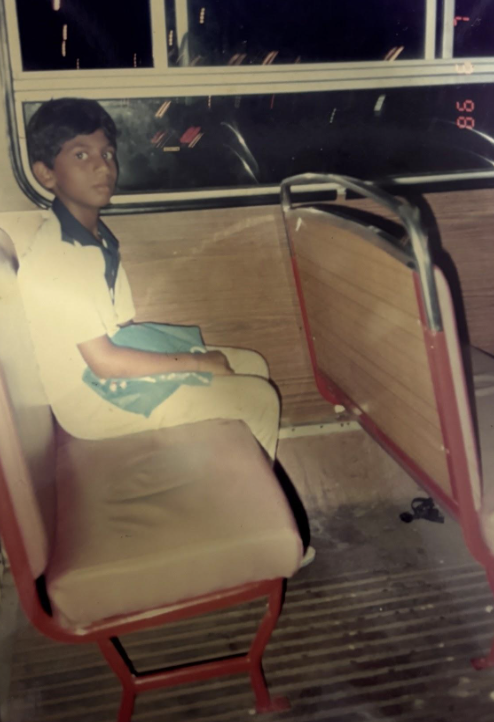
A picture of Ahmeena Beevi’s son in an old fashion bus (Photo Credit: Ahmeena Beevi)
.
From Open-Air Buses Then to Smart Transport Now
As the MooVita bus rolled on, my grandma started reminiscing. Grandma shared with us a photograph she clicked in 1986, of her son (my dad) on board one of Singapore’s public buses at the time.
“In the past, buses didn’t even have air-conditioning,” she said. “No accessibility features like ramps for wheelchairs too. When it rained, all the water would come in and everything got wet.” Grandma mentioned how instead of windows, public buses used to have railings to hold on to with seats that were like benches mounted to the bus floors.
Public transport, she said, used to feel inconvenient and uncomfortable. Today, it’s smoother, faster, and more reliable. “Almost like airplanes,” she joked.
Now, commuters are able to track bus timings on apps, pay with their phones, and soon, even ride autonomous buses across districts. “People are more educated now, and they use that knowledge to improve Singapore,” my grandma said.
As she spoke, it struck me that the advancements in public transport we see today have been built on decades of gradual change. For my grandma, the bus ride was not just about technology, but also a show of how far Singapore’s transport infrastructure has grown.
What’s Next for Autonomous Transport in Singapore?
Autonomous transport is set to become a more visible part of daily life in Singapore. In Punggol, the country’s first autonomous shuttle service is expected to open to the public by the second quarter of 2026, bringing driverless rides into neighbourhoods.
Beyond this, larger-scale deployments are also in the works. According to an article by The Straits Times, an $8.1m contract has been awarded for 16-seat vehicles to ply routes in Marina Bay and One-North as well. These buses are set to operate along public routes, further expanding the presence of autonomous vehicles beyond trial zones.
In order to guide these developments, the Ministry of Transport (MOT) announced in July 2025 that a 17-member committee has been formed to steer the progressive introduction of autonomous vehicles in Singapore. For young Singaporeans, this means autonomous vehicles will soon shift from something we read about to something we experience and integrate into our daily lives.
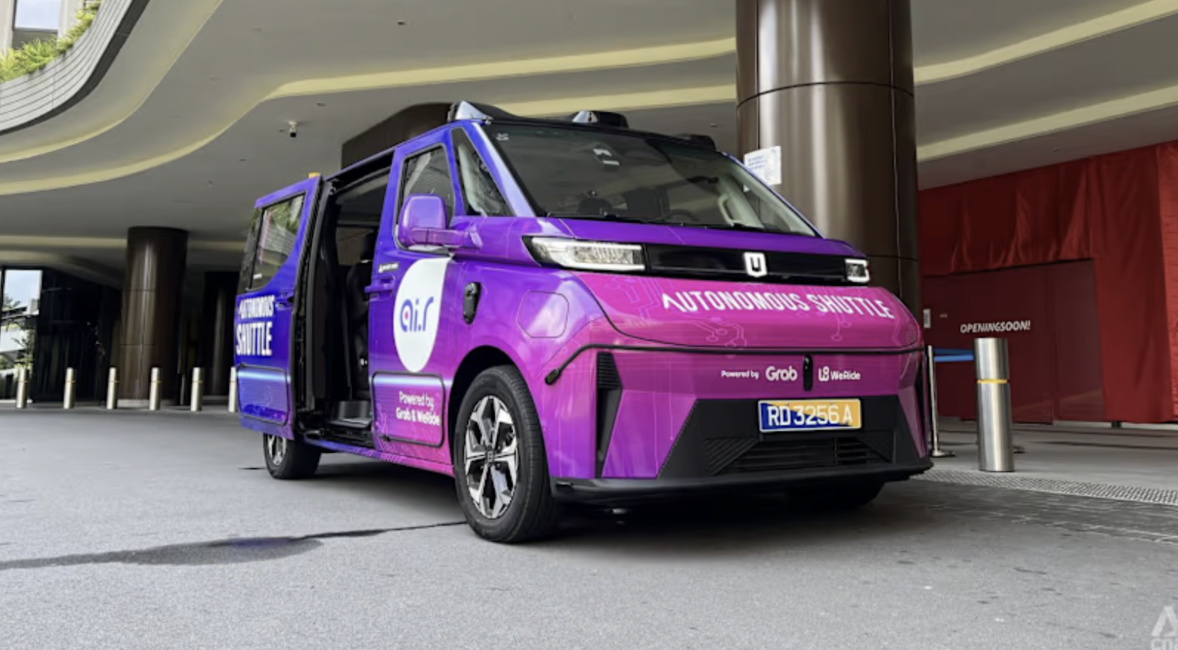
Autonomous shuttle service to be deployed at Punggol (Photo Credits: CNA/Erin Liam)
.
Keeping Up With Change
After the MooVita bus completed a loop around campus and came to a stop, we alighted the bus and I asked my grandma what she thought about a future where AVs take over Singapore’s roads.
“If there’s no one in the bus at all, I might be scared,” she admitted. “But if someone is there to ensure safety, I’ll take it.”
My grandma admitted that adapting to such changes may come more easily to younger people compared to those in her generation. However, she did point out that as times change, she believes she must move forward with it too, even if it takes a bit longer for her to fully accept driverless vehicles.
Seeing my grandma warm up to the idea of autonomous vehicles was a good reminder that embracing change and being willing to try is an important reason why Singapore’s public transport system has evolved to become one of the most efficient in the world today. As Singapore moves towards a more autonomous future, youths have a big role to play in helping each other adapt to these changes. And if my grandma is willing to do it, I’m sure we can too.