
Side Hustle to Streetwear: How Aston Abode Built a Fashion Community
BY
JULIA ONG
Social Media Head (UW)
Hype Issue #85
Published on:
Jan 23
2025
JULIA ONG explores how a youth-run clothing brand built a community of niche fashion curators in Singapore’s changing retail scene
If you grew up shopping in Singapore, chances are clothing from Uniqlo, H&M, or Zara has passed through your wardrobe at least once. Singapore’s fashion scene has been dominated by global brands for years. However, among younger consumers, a different kind of label is gaining ground — one built around community instead of scale.
Streetwear brand, Aston Abode, is one such example. Founded by Ngee Ann Polytechnic students, Lee Jung Sek, a final-year Information Technology student, and Kai Tham, a Business Studies alumnus, in 2023, the streetwear brand has grown from a reselling side hustle into a physical presence at youth hubs like *SCAPE. Its rise is a reflection of a broader movement towards ‘made in Singapore’ clothes.
Using Reselling to Build a Foundation
Rather than rushing to launch original designs, Lee and Tham took a different route and used a reselling model to identify what local youths actually wanted to wear. By hosting pop-up events across local polytechnics, they quickly managed to establish a foundation of loyal customers.
“We started off as vintage resellers, and that’s where we started building traction and a real community of loyal customers,” said Lee. “In 2025, we completely transitioned to selling our own products. We saw the potential because our existing community really enjoyed the small designs we experimented with, like caps and shirts.”
The Rise of Niche Online Fashion Communities
Aston Abode’s growth is part of a larger trend where digital spaces like Telegram and Discord have become the new “shopping malls” for Singaporean youths. Unlike traditional e-commerce, these platforms allow for a “drop culture”, which refers to scheduled releases that create urgency and exclusivity.
For streetwear brands in particular, this model works because the community already exists. The term ‘streetwear’ is rooted in overlapping subcultures such as music, contemporary art, and sports. These shared references create a sense of identity that extends beyond clothing itself.
In 2026, the global streetwear market size is estimated at US$218.3 billion, with Asia Pacific being its largest and fastest growing market. With the integration of social media platforms, streetwear marketing has transformed, allowing brands to create viral product launches and maintain consumer engagement.
For fashion brands such as Aston Abode, tapping into streetwear as a niche means engaging with consumers who are already connected through common interests and online communities. Platforms like Telegram and Discord allow brands to speak directly to these groups, bypassing traditional advertising channels. As a result, fashion becomes participatory: customers are not just purchasing garments, but actively taking part in a community shaped by shared tastes, conversations, and events.
Trendjacking and Subverting the “Basic”
In modern marketing, “trendjacking”, the act of capitalising on trending memes or viral internet moments, is a common tool for reaching youths. On the other hand, Aston Abode differentiates itself by starting each piece with a story, subverting the very trends they acknowledge.
While many brands chase “micro-trends” like salvaged denim or specific boxy cuts, Aston Abode’s identity is built on what they call “Your intrusive thoughts with refined taste.” This approach pairs quirky, meme-inspired humour with a focus on technical quality, such as specific fabric breathability and sleeve fit.
Lee explains how this philosophy works in practice. “For example, [take] the recent Henley shirts…. Yes, they are a trend. Then the question was, ‘How do we take such a trendy item and make it timeless?’” Lee said. “And we found all the issues with the current Henley shirt and how it was designed. You know, it’s too tight on the sleeves. You feel like it’s too hot… or you feel like the length might be too long. So we made adjustments based on those issues that we found, and we addressed each pain point with a feature in our piece. And we turned it into something that tells a story, solves the pain point; something that you would wear even after the trend has died.”
By focusing on “pain points” and timelessness, rather than just aesthetics, the brand positions itself as a higher-quality alternative to fast fashion.
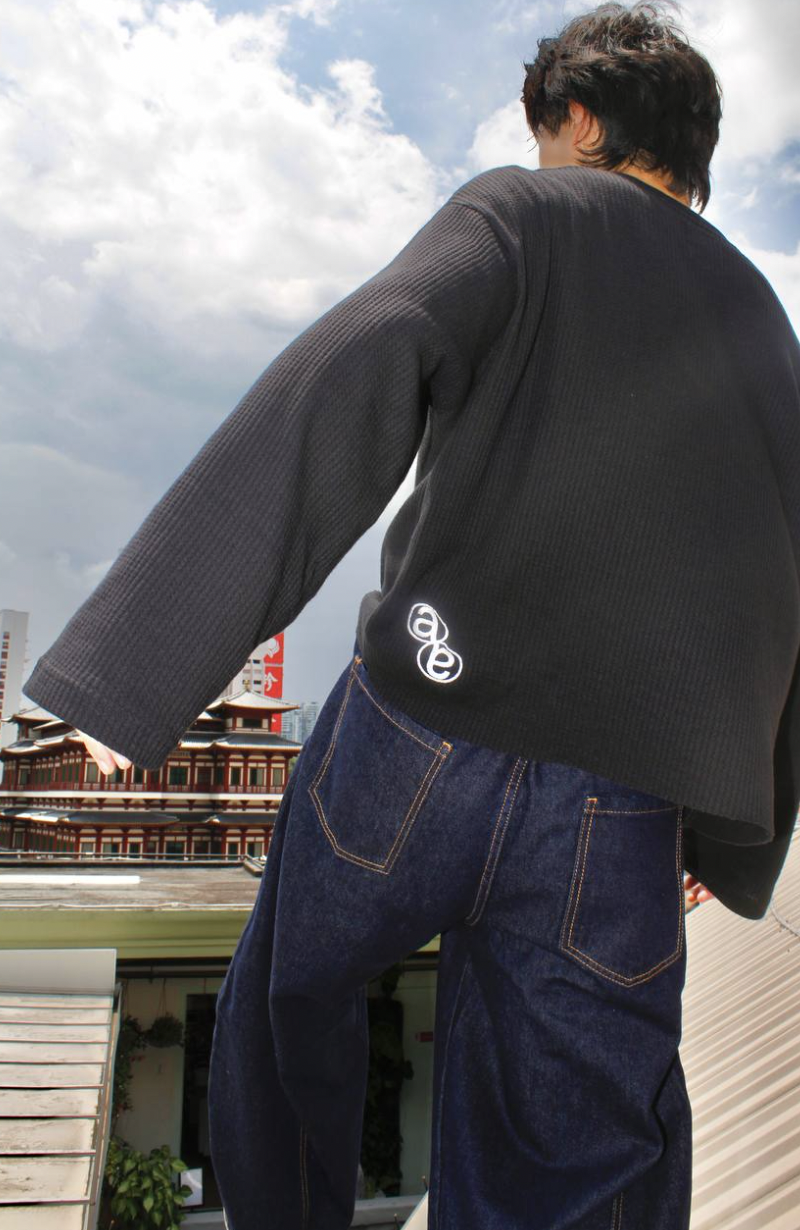
The Henley shirt made timeless by Aston Abode (Credits: Aston Abode)
Building Community Through Events
The brand’s growth is fueled by a Telegram group of over 3,000 active members. Unlike traditional brands that use social media as a one-way broadcasting tool, Lee and Tham maintain a daily dialogue with their followers.
“We have our Telegram community,” Lee said. “We will send out messages almost every other day, [where we] interact with our community. Then, they will reply in the thread below, and we will just strike up a conversation.” While this happens almost daily, Lee enjoys having one-on-one talks with his community during their in-person events.
“During these events, hundreds of people come down, and that’s when we actually talk to them in real life,” He said. “We [Aston Abode] go around, and I’ll just talk to everybody and I’ll just ask like, ‘Hey, do you guys like this? Like, how do you think of the event so far? What do you think we can do better? And then they will actually give their own genuine feedback face to face, and I think that is something that is really, really priceless.”
This community-first approach has culminated in Aston Abode’s successful events that bridge the gap between digital interaction and real-world loyalty.
In September 2025, the brand hosted “Daylight Frenzy” at the Kada Atrium, where members get to preview new collections and engage with each other through free photobooths and interactive social spaces. They have also hosted events like “Bricklane @ Aston”, which featured live screenprinting and vintage archives.

A pop-up event, ‘Backroom Archives’, at *SCAPE in collaboration with KOYUYU, featuring curated fashion vendors, DJs, photobooths, and jaguar tattoos. (Credits: Aston Abode)
.
This strategy has helped the brand expand beyond Singapore. They recently held a community event in Bali and have seen orders come in from the United States and Australia. “That was really, really nice to know it’s not just Singapore (customers), there are people who enjoy what we do in other countries,” Lee said. “Social media has played a very big part in that.”
A Growing Market for Local Labels
Aston Abode’s rise mirrors a broader shift in the Singaporean apparel industry, which recorded revenues of $3.6 billion in 2024. This growth was pioneered by local brands like Beyond The Vines, The Paper Bunny, and Love, Bonito. These companies prove that local brands can scale by addressing specific local needs, such as Love, Bonito’s focus on Asian fit or Beyond The Vines’ blend of luxury and accessibility.
With research showing that 62% of consumers now watch social videos before making a purchase, Aston Abode’s decision to rely entirely on organic content reflects where youth culture is heading. In an industry built on speed and scale, community has become the new currency.