
The Work Behind the Wok: The Cost Of Keeping Hawker Culture Alive
BY
WAFEEQA SULAIMAN
Deputy Editor
Hype Issue #83
Published on:
Jan 16
2026
WAFEEQA SULAIMAN uncovers the daily realities hawkers face and how the Mee & You initiative is bringing these stories to light.
On 2 January 2026, a fire broke out at a hawker stall located in Hong Lim Complex. Five days later, its shutters were still down. The owner of the stall, Teo Koon Guan, 80, had been running his hawker stall for more than two decades but is now left at his wits’ end.
Most of us probably saw the news, felt a pang of sympathy… and scrolled on.
Another headline. Another incident. Another sad story.
But for Teo, this wasn’t just another headline. It was a real-life struggle, one that countless hawkers face every day.
More Than Just Food on a Tray
For many, hawker centres are the go-to when they don’t know what to eat or need a cheap and convenient meal. But behind every plate is a hawker calculating more than just ingredients.
Like Mr Teo, today’s hawkers face an unstable mix of rising rental and utilities bills, fluctuating ingredient prices, manpower shortages, and increasing pressure to digitalise their processes. Yet even as costs rise and manpower shortages stretch hawkers thin, their food prices are still expected to stay low.
“Almost every day, we encounter customers complaining about prices,” said Mr Melvin Chew, a second-generation hawker and the founder of Hawkers United SG.
Hawkers largely rely on themselves or family members to keep their operations running. But despite long hours, physically demanding work, and slim profit margins, they continue to show up at their stalls each day, driven by respect for their craft and a commitment to serving familiar, well-loved meals to their customers.
.
Speaking Up When Others Can’t
At the height of Covid-19, Mr Chew started Hawkers United to support elderly hawkers who were struggling to adapt to rapid changes. Many were unfamiliar with technology and delivery platforms, leaving them especially vulnerable when dining-in was not an option.
By pooling help from younger hawkers, Mr Chew built a community that helped hawker stalls hop on delivery platforms, posted content about their stalls on social media, and ensured they were not left alone during a time of crisis. The Hawkers United Facebook page has since grown to a community of more than 300,000 followers, continuing to shed light on hawker stalls around Singapore.
Mr Chew, who has been running Jin Ji Teochew Braised Duck & Kway Chap since 2014, grew up in hawker centres, helping out at his parents’ stall from the age of 17.
“I’ve seen how hard my parents worked. Many elderly hawkers work their whole lives. But, when they reach retirement age, they don’t get to enjoy it. They’re full of illnesses like leg pain and joint pain but they still have to keep going,” he shared.
Since starting Hawkers United, Mr Chew has also worked with local Members of Parliament (MPs), raised concerns directly to them, and advocated for changes to better support hawkers. He believes that change will not happen overnight, but with consistent effort, Mr Chew aims to alleviate some burdens that hawkers face today while continuing to cherish Singapore’s vibrant hawker scene.
When “Mee & You” Step In
Inspired by a similar belief, Mee & You, a Final Year Project by Ngee Ann Polytechnic Community Development students, chose to focus on hawkers, not just as symbols of heritage, but as hardworking individuals too. The students aim to foster empathy for the daily realities hawkers face, encourage appreciation for them and inspire “(you)ths” to show more support to hawker businesses.
Lim Ke Ying, a Year 3 Community Development student and representative from Mee & You, shared with us how this topic struck close to home, both for herself and her teammates.
“Some of us have loved ones who are hawkers. Others are frequent diners at hawker stalls. This propelled us to want to let people know about the hidden struggles and hard work that goes into being a hawker,” she shared.
Through months of interviews and ground research, the team uncovered recurring challenges: such as long working hours in hot environments, repetitive physical labour that leads to injuries, declining footfall as diners turn to trendier options, and the pressure for hawkers to adapt quickly to digital systems.
Turning Empathy Into Experience
Going beyond simply raising awareness, Mee & You designed programmes that allowed youths to experience first-hand the struggles hawkers face on a daily basis.
At their Hawker Appreciation Day on 23 November 2025, youth volunteers interacted directly with hawkers to show their gratitude by distributing essentials like first aid kits and grocery vouchers. The event drew attention from community leaders, including Mr Chew of Hawkers United and Minister Desmond Lee, helping to amplify hawkers’ voices.

Mee & You team with Melvin Chew of Hawkers United and Minister Desmond Lee at Hawker Appreciation Day (Photo Credits: Mee & You)
As a follow-up, the team also created a roleplay game booth on campus, where students got to experience juggling orders, managing time constraints, and fulfilling customer demands, simulating the intensity of running a hawker stall.
Hype SG joined Mee & You as participants at their most recent initiative, the Hawker Guided Trail. The trail took place in Clementi, bringing volunteers directly to hawker stalls to hear their stories firsthand, humanising an occupation often taken for granted.
Using Mee & You’s specially curated trail booklets, we set off to different points on the trail, for activities such as Hear “Mee” Out, where volunteers played a game to guess which stall a specific voice recording came from. The distinct sounds of knives against chopping boards and stir-frying in a wok served as a reminder of the repetitive motions hawkers carry out daily, often under intense heat and physical strain.
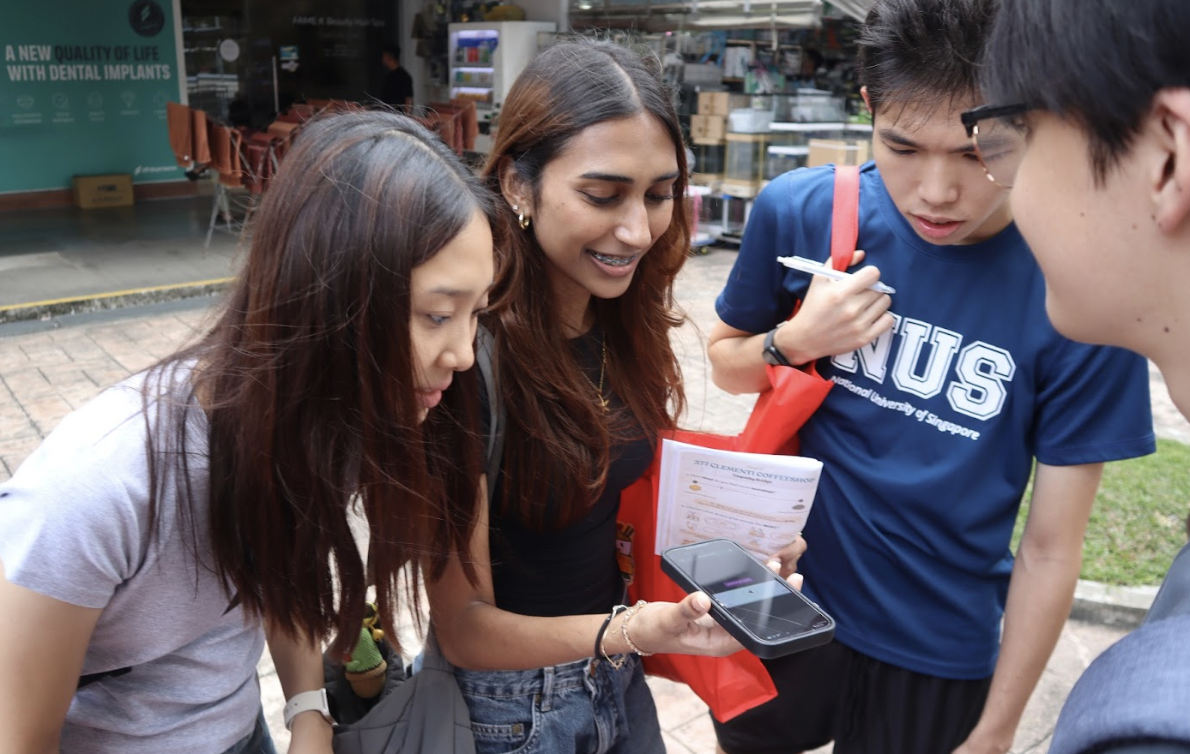
Mee & You volunteers playing the Hear “Mee” Out activity (Photo Credits: Wafeeqa Sulaiman)
.
Other pit stops on the trail included the Sinar Bahru Muslim Stall run by Mdm Rosmalia, where we explored what her daily routine looked like. We learnt that she wakes up as early as 3 am every day, just to prepare the food sold at her stall. Despite this, it was heartwarming to see how she was all smiles and kept up a cheerful demeanour as she was cooking up dishes to serve to her customers.
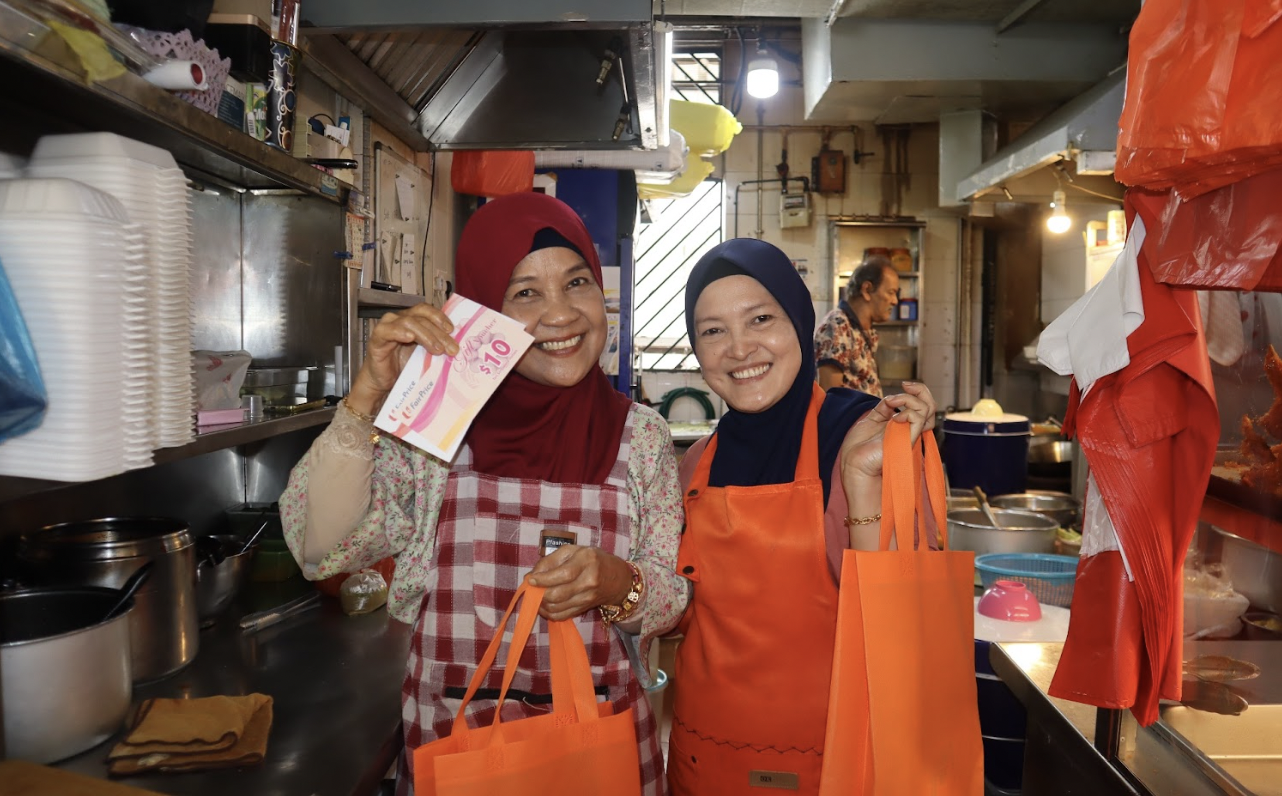
Mdm Rosmalia (right), receiving tokens of appreciation from Mee & You (Photo Credits: Wafeeqa Sulaiman)
.
Our guided trail ended at Clementi Library, where we came across a community wall set up by Mee & You in collaboration with the National Heritage Board’s Heritage Activation Node (HAN) initiative and the National Library Board (NLB). The showcase, which will be on display for three months, invites visitors to engage with the stories behind hawker stalls.
Through a series of flip books created by the team, we read personal accounts of hawkers, which included their routines, sacrifices, and resilience. We were also encouraged to pen handwritten notes of appreciation, turning the wall into a living celebration of hawkers in Singapore.
Saving What We Have
Choosing hawker food when possible, being patient, understanding price increases, and supporting initiatives that uplift hawkers are all simple ways youths can play their part in supporting hawkers.
“We are not asking the next generation of youths to go and be hawkers themselves, but when we recognise the hard work and labour behind the food hawkers make, appreciation for them starts to turn into action,” Ke Ying shared.
Hawker culture is often celebrated as heritage and as uniquely Singaporean. But, at its heart are individuals who have chosen to dedicate their lives to a demanding craft.
“There are some traditional foods made by masters that cannot be replicated,” Melvin said. “If we don’t support them, we end up losing them.”
The story of the fire that broke out at Hong Lim Food Centre may have faded from headlines, but the people behind these very hawker stalls will keep waking up before dawn, standing to serve customers for hours, and carrying on as long as they can.
Showing our appreciation to hawkers does not require grand gestures. It begins with noticing the labour behind each plate, valuing consistency over convenience, and choosing to support the stalls that have quietly fed generations. When we do so, keeping hawker culture alive becomes a point of national pride, a shared responsibility, and not a burden carried by hawkers alone.
i enjoy reading this great article, i have shared it many times on my website and started following you, Do you post more often ?? i am the owner of https://webdesignagenturbayreuth.de/ a webdesign agency in bayreuth Germany, webdesign agentur bayreuth, you can link up if you are interested. Thank you
Thi is a great article no doubt about it, i just started following you and i enjoy reading this piece. Do you post often ? we have similar post on the german best freelancer platform called https://webdesignfreelancerdeutschland.de/ you can check it out if you want. Thank you
Thi is a great article no doubt about it, i just started following you and i enjoy reading this piece. Do you post often ? we have similar post on the german best freelancer platform called https://webdesignfreelancerdeutschland.de/ you can check it out if you want. Thank you
The Smart Way to Find Your Lost Crypto Wallet. https://cryptofinder.pythonanywhere.com
This is my first time pay a quick visit at here and i am really happy to read everthing at one place
I’m often to blogging and i really appreciate your content. The article has actually peaks my interest. https://heosexhay.net/ I’m going to bookmark your web site and maintain checking for brand spanking new information.
Bahis, çeşitli kullanıcı dostu para yatırma ve çekme yöntemleri sunan bir bahis şirketidir
Good post! We will be linking to this particularly great post on our site. Keep up the great writing
You’re so awesome! I don’t believe I have read a single thing like that before. So great to find someone with some original thoughts on this topic. Really.. thank you for starting this up. This website is something that is needed on the internet, someone with a little originality!
There is definately a lot to find out about this subject. I like all the points you made
dxd global | Marka yönetimi Kıbrıs , sosyal medya yönetimi, promosyon ürünleri, Seslendirme Hizmeti , SEO , Dijital pazarlama , Videografi
Nice post. I learn something totally new and challenging on websites
The Easy Way to Find Your Lost Crypto Wallet. https://coinomie.netlify.app
I like how you avoided hype and just focused on explaining how things actually work.
Very well presented. Every quote was awesome and thanks for sharing the content. Keep sharing and keep motivating others.
QQ88 là nền tảng cá cược trực tuyến uy tín, tích hợp casino live, nổ hũ, bắn cá và thể thao với trải nghiệm ổn định.
Protect Your Digital Assets: AI Wallet Finder. https://cryptofinder.pythonanywhere.com
This is my first time pay a quick visit at here and i am really happy to read everthing at one place https://heosexhay.net/
A valuable addition that keeps the discussion focused and aligned.
부천출장안마